Rafael Cornejo
(rafaelcor3310@gmail.com)

In a recent LinkedIn post, the World Customs Organization (WCO) reported on the results of the 78th Session of the Harmonized System Committee. Two points mentioned in that post particularly caught my attention: the corrections to the correlation tables between the 2022 and 2028 editions of the HS, and the provisional adoption of a first amendment to the future HS 2033 Nomenclature. Taking October 1, 2026 as the reference date, there are 457 days remaining until the HS 2028 enters into force and, assuming January 1, 2033 as the effective date of the following edition, 2,283 days until the latter.
Since its entry into force, the Harmonized System has had seven editions, the current one being the 2022 edition. An eighth edition, already approved but not yet in force, will follow in 2028. To facilitate the transition between editions, the WCO Secretariat, following instructions from the Harmonized System Committee, prepares and publishes correlation tables linking each new edition of the HS with the immediately preceding one, in both directions. There are currently six pairs of such tables, ranging from the 1996–2002 correlation to the recently prepared 2022–2028 correlation. However, there is no single WCO table that directly correlates all historical editions with one another. Consequently, establishing the correspondence between non-consecutive editions—for example, between HS 1996 and HS 2022—requires successively linking the correlation tables for each revision.[1]
In this regard, the WCO itself clarifies that these correlation tables are intended solely as guidance to facilitate the implementation of new editions of the Harmonized System and have no legal status. It also notes that, in certain cases, different correlation possibilities may exist as a result of differences in the classification of certain goods (WCO, Correlation Tables HS 2022–2028, introductory paragraphs to Tables I and II).
Against this background, the question arises: how many rules of origin regimes currently in force have their annexes of product-specific rules available today in the HS 2022 edition? The need to update these rules in response to successive amendments to the Harmonized System has received increasing attention. The WCO itself has prepared a Guide designed to facilitate the technical updating of rules of origin from earlier HS editions to more recent editions,[2] and some agreements have already updated their product-specific rules to HS 2022. However, much remains to be done. In Latin America, numerous agreements still have product-specific rules of origin expressed in earlier editions. Some even continue to use editions dating back to the last century, such as HS 1996.

Impact on Operators in a Preferential Export Transaction
In analyzing the relationship between amendments to the Harmonized System and the rules of origin of trade agreements, the United States International Trade Commission (USITC) emphasizes that successive editions of the HS may alter the scope of headings and subheadings. This observation is particularly relevant because it highlights that moving from one HS edition to another does not necessarily involve a simple substitution of codes: the same classification may not retain exactly the same content or scope.
The USITC applies this reasoning directly to rules of origin and warns that, if those specific and updated subheadings are not taken into account in the rules of origin of trade agreements, those rules may no longer adequately address the products concerned. This observation confirms a central point: updating product-specific rules of origin requires considering not only the correspondence between codes in different HS editions, but also the changes that those editions may have introduced in the content of the classifications on which the rules were formulated.[3]
This observation is also consistent with the bidirectional nature of the relationship between the Harmonized System and rules of origin based on a change in tariff classification, a relationship that this author has identified and analyzed in previous work when examining the effects that successive revisions of the Harmonized System may have on the application of these rules.[4]
Indeed, when defining product-specific rules of origin, the Harmonized System serves two purposes. The first is essentially organizational: negotiators use its numerical structure—chapters, headings and subheadings—to organize and identify the rules that a good must satisfy in order to qualify as originating. But there is a second, even more significant use when the origin requirement is defined by the change or shift that certain inputs must undergo within that structure. In such cases, the Harmonized System ceases to be merely the instrument used to identify and organize the rules and becomes part of the very condition that determines the origin of the good.
It is precisely this second use that creates an additional and more complex difficulty, specific to the field of origin, as successive HS revisions take place. These revisions not only modify the codes used to identify products, but may also alter the content or scope of certain headings or subheadings: products covered by one tariff provision may move to another, a provision may be split, several provisions may be consolidated, or the range of products covered by them may change. Consequently, if the rule of origin remains expressed in an earlier HS edition, these changes may affect the identification and scope of the inputs subject to the change in tariff classification and, depending on the nature of the change, may make the originally negotiated rule either more flexible or more restrictive.
Put in more operational terms, the issue is not simply one of finding the equivalent of an old code in a new nomenclature. An HS revision may alter the universe of inputs originally covered by the requirement established in the rule and, in doing so, broaden or narrow the range of products subject to the change in tariff classification. Consequently, what may potentially be altered is not merely the numerical tariff classification of those inputs, but the substantive scope of the rule of origin originally negotiated.
How, then, does this situation affect the operators involved in a trade transaction, and what challenges does it pose for them? To examine these effects, the tasks performed by the principal actors involved in the process of determining, declaring, certifying and importing an originating good will be considered in turn: the producer, the exporter and importer, the certifying entity—where applicable—and the customs authority of the importing country.
The producer of the good plays a decisive role in determining its originating status, since the producer possesses the information concerning the production process, the materials used and their origin. For a good to qualify as originating, its production process must necessarily comply with the requirements established in the applicable product-specific rule of origin under the agreement pursuant to which the export takes place. Consequently, the producer’s selection of inputs and whether those inputs are originating or non-originating ultimately determine compliance with the rule. Once the product has been manufactured, its production process cannot be retrospectively modified to make a good originating if it failed to meet the applicable requirements. The only alternative, where the agreement so permits, is to determine whether the good satisfies another rule of origin provided for the same product. This option, however, is not always available, since for many products only one rule has been negotiated.
Therefore, when a rule based on a change in tariff classification applies, the producer must determine in advance which inputs may be used as non-originating and which must necessarily be originating. This underscores the importance of correctly identifying the applicable product-specific rule of origin in advance.

As noted above, since there is no single table correlating all HS editions with one another, the number of correlations that the producer will need to perform will depend on how old the HS edition is in which the product-specific rules of the agreement under which the good will be exported are expressed. These correlations will be necessary both to identify the rule of origin applicable to the product and, where compliance with that rule requires examining the non-originating inputs used in its production, to determine the classification of each of those inputs. Table 1 shows the number of successive correlations that would need to be performed depending on the HS edition in which the annex containing the Product-Specific Rules of Origin—that is, the rules of origin applicable to each product under the selected agreement—is expressed.
Table 1. Number of successive correlations required according to the HS edition of the Product-Specific Rules of Origin
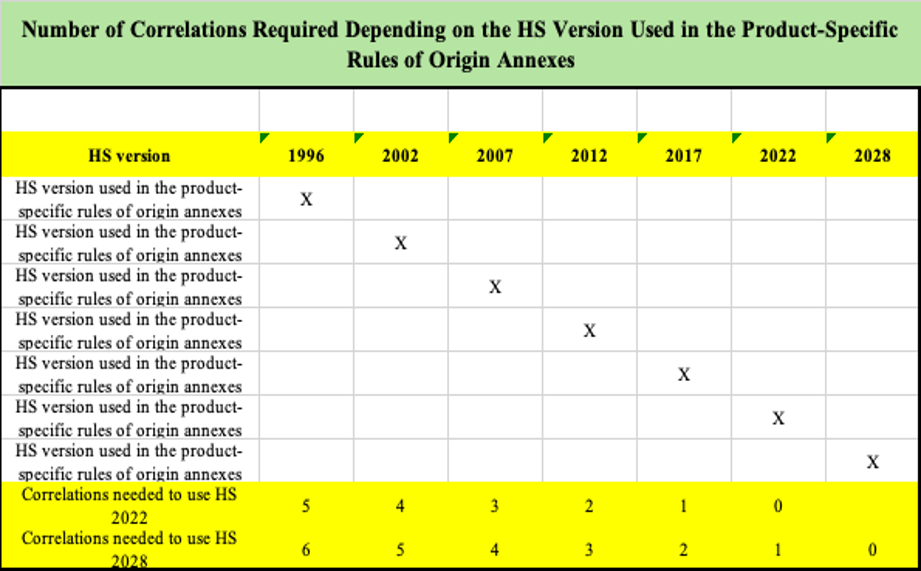
When the certification and/or declaration of origin is made by the exporter or importer rather than by the producer of the good, that party must, at a minimum, verify the correlation performed for the product in order to correctly identify the applicable rule of origin. This information is essential not only because it may, in some cases, be required for origin certification purposes, but above all because the person certifying assumes responsibility for declaring the good to be originating. Based on the rule identified, that party must also carry out whatever checks it considers necessary to obtain sufficient information regarding the production of the good and thereby assume legal responsibility for declaring it originating.
Where the agreement provides for the involvement of public or private certifying entities, they must identify the applicable rule of origin by correlating the tariff classification of the exported good under the current nomenclature with its equivalent classification in the HS edition in which the Product-Specific Rules of Origin are expressed. This task must be performed when reviewing the declaration of origin or issuing the certificate based on that declaration. Subsequently, based on the criteria established in the rule identified, the entity must carry out whatever checks it considers necessary to verify and validate the producer’s declaration. Where the rule is based on a change in tariff classification and non-originating inputs have been used, the entity must also correlate the classification of those inputs whenever necessary to determine whether their use is permitted under the rule of origin.
Similarly, any origin control or verification procedure concerning the same product will require the authorities of the importing country to identify the applicable rule of origin once again and, consequently, to perform the necessary correlations. With respect to the inputs incorporated into the product, the scope of this task will depend on the intensity of the control performed. This may vary depending on the channel through which the import is processed by customs and may be considerably more exhaustive if an origin verification is subsequently undertaken, since this will require a detailed examination of the originating status of the inputs used.
It follows that, in the course of a single trade transaction, three or four of the actors mentioned above are very likely to perform, at different stages, the same correlation tasks. These tasks are not always straightforward, particularly when the age of the HS edition in which the Product-Specific Rules of Origin are expressed requires several correlation tables to be linked in order to reconstruct the traceability between nomenclatures. This repetition in itself results in duplication of tasks and administrative costs, increasing the cost of both the trade transaction and its control.
Against this background, it is worth asking whether all of these actors will arrive at the same interpretation and the same results from the correlations they perform. This will depend, among other factors, on the changes undergone by the classification of the product and its inputs across successive HS editions. If different results are reached, the administrative costs involved in performing the correlations may be compounded by delays, disputes and potential economic losses for the exporters and importers involved in the same trade transaction.
The magnitude of these correlation tasks also depends on the intensity and variability with which change in tariff classification is used in Product-Specific Rules of Origin. Intensity is determined by the number of rules or tariff provisions that use this criterion, while variability derives from the different forms it may take: change of chapter, heading or subheading, in each case with or without exceptions. These differences are relevant because they determine both the number of inputs and products potentially affected by the need to perform correlations and the complexity those correlations may entail.
The sample of trade agreements included in Table 1 of Annex I provides an indication of the significance of these factors. In the agreements examined there, between 67% and 97% of the first rules of origin applicable to products use a change in tariff classification, although there are significant differences in the level of change required and in the use of exceptions.

An Applied Example of Correlation Between Editions of the Harmonized System
The complexity of these correlations becomes clearer through a concrete example. For this purpose, we can use residual subheading 1211.90, “Other,” within heading 12.11 of the Harmonized System, and reconstruct its correspondence across successive editions of the nomenclature, as shown in Table 2.
Table 2. Example of a Correlation Across Several Editions of the Harmonized System
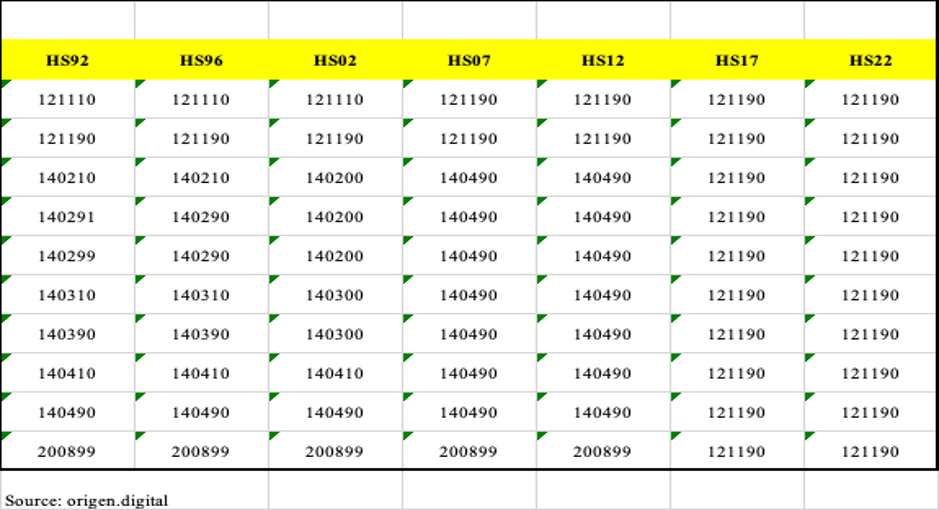
Subheading 1211.90, “Other,” belongs to heading 12.11 of the Harmonized System, which covers plants, parts of plants, seeds and fruits used primarily in perfumery, pharmacy, or for insecticidal, parasiticidal or similar purposes. Within this heading, liquorice roots (1211.10), ginseng roots (1211.20), coca leaves (1211.30) and poppy straw (1211.40) are specifically identified, while the remaining products covered by the heading are grouped under residual subheading 1211.90, “Other.”
The problem becomes more apparent when tracing the Harmonized System backwards through successive editions. Moving back to the 2017 edition, identifying subheading 1211.90 presents no major difficulty. However, as the analysis continues further back through earlier nomenclatures, what initially appeared to be a straightforward correspondence begins to branch out: tariff provisions associated with Chapters 14 and 20 emerge and, as the process continues, some of them undergo further changes in numbering or content.
Thus, what at first sight might appear to be a simple correspondence between codes can become a considerably more complex exercise, since the correlation must be established on the basis of the content and wording or description of the respective tariff provisions. If an agreement’s product-specific rules of origin remain expressed in an older HS edition, anyone seeking to apply them to a good classified under the current nomenclature will have to reconstruct this path and determine which of the different correspondences applies to the product concerned.
In addition, the need to perform similar tasks repeatedly, with potentially different results, appears to raise a contradiction when viewed from a trade facilitation perspective. The WTO Trade Facilitation Agreement seeks to ensure that regulations applicable to trade transactions are published and made available to operators sufficiently in advance so that they can become acquainted with them before their entry into force. Although it makes no specific reference to the edition of the Harmonized System used, this principle of transparency and predictability raises the question of whether it is reasonable for trade agreements to be expressed in an obsolete edition and, moreover, for agreements to begin to be applied with texts governing some of their disciplines expressed in a nomenclature that is no longer in force in the country.
The choice of a subheading described as “Other” was not accidental. Correlation between editions of the Harmonized System is not established on the basis of numerical similarity between codes, but rather on the content and wording or description of the respective tariff provisions. “Other” subheadings are residual in nature and therefore lack a description that positively identifies the products they cover. Their content is not self-contained, since it consists of the products covered by the heading that are not specifically identified in its other subheadings. Consequently, determining the content of an “Other” provision also requires knowing the content of the other provisions within the heading. This characteristic makes their correlation across different HS editions particularly complex. Because of the heterogeneous nature of their content and the manner in which they are constituted, these subheadings are often referred to as “basket provisions.”
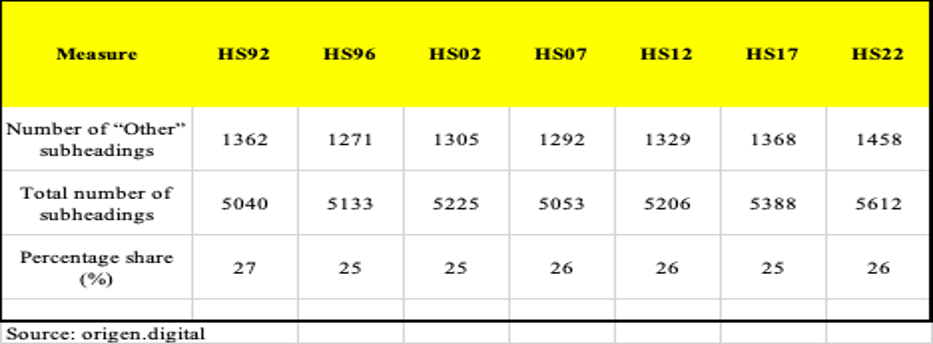
One might assume that this type of subheading is relatively uncommon. However, Table 3 shows the number of subheadings described as “Other” in each of the HS editions considered. Taken together, they account for approximately one quarter of the nomenclature.
Table 3. Number of “Basket” Provisions and Their Share in Each HS Edition

Against this background, it is useful to examine how the problem of this lack of updating has been addressed in certain agreements and countries. Recent experience reveals different approaches and responses to the mismatch between the HS edition in which product-specific rules of origin are expressed and the nomenclature in force when those rules are applied, including the following:
- USMCA (Canada–United States–Mexico). The Agreement entered into force in July 2020, but its product-specific rules of origin were drafted using the HS 2012 nomenclature. These rules continue to be expressed in that edition; consequently, changes introduced in subsequent editions of the Harmonized System may require determining the correspondence between the codes used in the Agreement and those of the current nomenclature. The United States International Trade Commission (USITC) itself expressly notes that the USMCA rules were drafted using the HS 2012 nomenclature and that, where those codes have changed, they must be mapped to the corresponding HS 2022 codes.[5]
- United States–Peru. In February 2024, on the occasion of the Sixth Meeting of the Agreement’s Free Trade Commission, the two countries reported that they had worked on updating the product-specific rules of origin to align them with the Harmonized System 2022 and stated their objective of implementing the revised rules as of January 1, 2025. However, no instrument formally bringing that update into force has been identified in the subsequent official documentation reviewed, and both Peru’s Ministry of Foreign Trade and Tourism (MINCETUR) and the Office of the United States Trade Representative (USTR) continue to publish on their respective official websites Annex 4.1 corresponding to the previous edition of the Harmonized System.
- Peru-China. The agreement currently in force contains its product-specific rules of origin expressed in HS 2007. The Optimization Protocol, signed on November 14, 2024, incorporates, among other amendments, a new Chapter 3 on Rules of Origin and Origin-Related Operational Procedures and a new Annex 3-A on Product-Specific Rules of Origin. Information published by China’s Ministry of Commerce indicates that the process includes the transposition of the product-specific rules of origin, although the source consulted does not identify the HS edition to which the rules are being transposed. According to information published by MINCETUR, the Protocol has been signed and is pending entry into force.
- CPTPP. This case illustrates particularly clearly how long the updating process can take. The members agreed to transpose the product-specific rules of origin from HS 2012 to HS 2017 and subsequently moved forward with their transposition to HS 2022. However, as of June 2024, some technical rectifications related to the latter transposition were still pending and the mechanism for its implementation was under discussion. In that context, Japan indicated that it would not deny preferential tariff treatment when the certification of origin used HS 2012 codes while this work remained under way. Australia, Canada and New Zealand likewise reported that they accepted certifications expressed in different HS editions. Canadian legislation giving legal effect to the CPTPP rules of origin, for its part, continues to refer to Annex 3-D of the Agreement.
- Additional examples, this time outside the sample considered above, can be found in the European Union’s agreements with Latin America, where it is particularly interesting to observe the different situations regarding the status of updates to product-specific rules of origin.
- European Union-Central America. The appendices containing the product-specific rules of origin were formally updated to HS 2022 through Decision No. 1/2023 of the EU-Central America Association Council of June 29, 2023.
- MERCOSUR-European Union. The product-specific rules of origin were negotiated and formalized on the basis of HS 2017. Consequently, the product-specific rules of origin are expressed in an edition of the Harmonized System that is no longer in force. In this context, Brazil opted for a practical and operational solution by preparing a list setting out the agreement’s product-specific rules of origin on the basis of the HS 2022 nomenclature. Although this list is exclusively informational, does not modify the negotiated requirements and has no legal effect for purposes of verifying origin, it offers an important advantage: it provides operators with an updated reference that facilitates application of the rules and avoids requiring them to individually perform the correlations between the two editions of the Harmonized System.
- In summary, the cases examined show that adapting product-specific rules of origin to successive editions of the Harmonized System and subsequently bringing them into force do not necessarily constitute a continuous or rapid process. The sample presents very different situations: agreements whose rules have already been formally updated to HS 2022; others in which the transposition processes are still pending formalization or entry into force; and cases in which operational solutions have been adopted that, without legally modifying the rules in force, facilitate their application using a more up-to-date nomenclature.
- This evidence is particularly relevant in view of the forthcoming entry into force of HS 2028. The experience examined shows that adapting origin regimes can take considerable time. Beginning this work early is therefore essential to prevent the entry into force of a new edition of the Harmonized System from once again widening the gap between the nomenclature used in trade and that in which product-specific rules of origin continue to be expressed.[6]
The cases described above also illustrate different approaches to addressing this mismatch between editions of the Harmonized System. On the one hand, there are situations in which the problem is, at best, acknowledged, while the product-specific rules of origin remain expressed in a nomenclature that is no longer in force. On the other hand, Brazil provides an example of a more proactive response: faced with the impossibility of unilaterally modifying the legally agreed text, the competent authority addresses the problem directly by providing an unofficial version of the rules expressed in the current nomenclature, thereby helping to guide operators and facilitate their application in preferential trade transactions.
The issue is not merely formal or legal. Modern trade agreements commonly entrust their Rules of Origin Committees with adapting product-specific rules to amendments to the HS. Some even provide for this work to begin before a new edition enters into force. As the cases examined show, these updates are not always carried out in a timely manner. Nevertheless, there is still time to prepare for the entry into force of HS 2028. Beginning now to update product-specific rules that remain expressed in earlier editions would make it possible to gradually address existing mismatches while also ensuring better preparation for their subsequent and more rapid adaptation to HS 2028.
Some Conclusions
Annex I. A Sample of the Scope of the Problem
In order to assess the intensity and variability with which change in tariff classification is used in Product-Specific Rules of Origin, Table 1 presents information on a selection of Peru’s principal trade agreements currently in force. The sample includes the agreements with the United States, the European Union and China, the CPTPP and, at the regional level, the Pacific Alliance and the agreement with MERCOSUR. It therefore covers agreements negotiated at different times and under different integration arrangements, with partners from different continents, including some of the world’s leading exporting and importing economies. negotiated at different times and under different integration arrangements. This diversity makes it possible to observe, across a geographically broad sample, both the intensity with which change in tariff classification is used and the variability of its requirements.
Although the sample is based on a selection of Peru’s trade agreements currently in force, its purpose is not to analyze a situation specific to that country. Rather, together with the additional cases examined below, it helps illustrate a broader issue: the need to keep product-specific rules of origin up to date in response to successive amendments to the Harmonized System.
Table 1. Use of Change in Tariff Classification in a Selection of Peru’s Trade Agreements
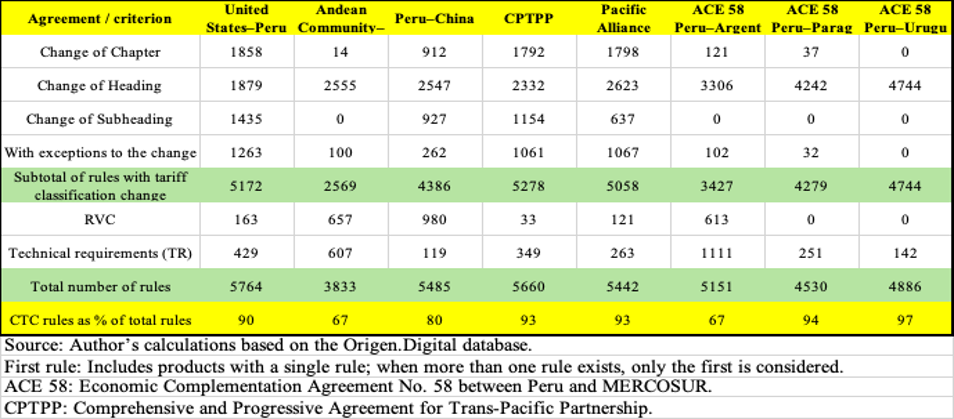
The preceding table shows, first, the strong predominance of change in tariff classification over regional value content or technical requirements in defining the first rules of origin applicable to a product. In the agreements selected, between 67% and 97% of the rules use this criterion. The table also shows considerable variability in the forms used: in some agreements, for example, the number of rules requiring a change of chapter or subheading is even greater than the number requiring a change of heading.
Another relevant point emerging from the table is the number of change-in-tariff-classification rules that incorporate exceptions to the required change. These exceptions extend the restriction to certain inputs that, even though classified outside the range covered by the change established by the rule, may nevertheless not be used as non-originating materials. Consequently, the tariff provisions corresponding to those inputs will also need to be correlated whenever the rule is expressed in an HS edition different from that used in the trade transaction.
Table 2. Nomenclature Edition and Status of the Updating of Product-Specific Rules of Origin in the Selected Agreements
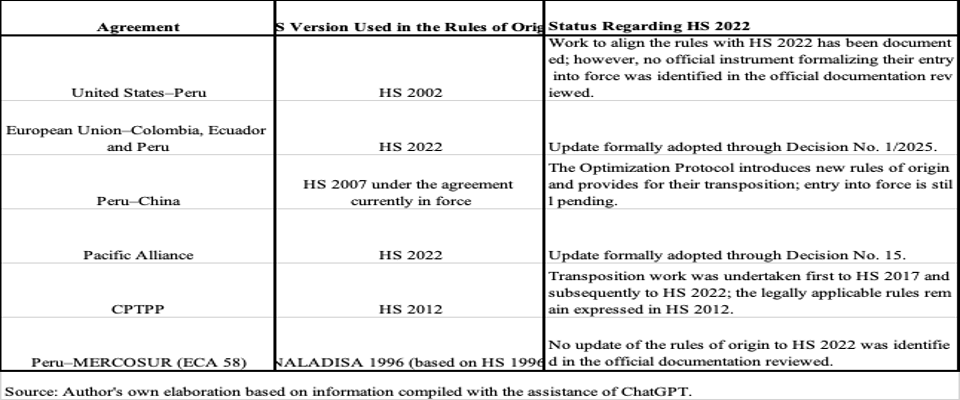
As Table 2 shows, the agreements included in the sample present very different situations regarding the updating of their Product-Specific Rules of Origin in response to successive amendments to the Harmonized System. In some cases, the product-specific rules have been formally updated to HS 2022, as in the Pacific Alliance (Decision No. 15, November 24, 2022) and the European Union agreement with Colombia, Ecuador and Peru (Decision No. 1/2025, June 19, 2025).
In other agreements, this adaptation process is still under way, as illustrated by the cases discussed below:
- United States–Peru. In February 2024, during the Sixth Meeting of the Free Trade Commission, both Parties reported that they had worked on technically trade-neutral modifications to adapt the product-specific rules of origin to HS 2022, with the aim of bringing them into force on January 1, 2025. However, no subsequent instrument formally implementing that update has been identified in the official documentation reviewed, and the official websites continue to publish Annex 4.1 expressed in HS 2002.
- Peru–China. The agreement currently in force contains its product-specific rules of origin expressed in HS 2007. The Optimization Protocol, signed on November 14, 2024, incorporates, among other amendments, a new Chapter 3 on Rules of Origin and Origin-Related Operational Procedures and a new Annex 3-A on Product-Specific Rules of Origin. Information published by China’s Ministry of Commerce indicates that the process includes the transposition of the product-specific rules of origin, although the source consulted does not identify the HS edition to which the rules are being transposed. According to information published by MINCETUR, the Protocol has been signed and is pending entry into force.
- CPTPP. This case illustrates particularly clearly how long the updating process can take. The members agreed to transpose the product-specific rules of origin from HS 2012 to HS 2017 and subsequently moved forward with their transposition to HS 2022. However, as of June 2024, some technical rectifications related to the transposition to HS 2022 were still pending and the mechanism for its implementation was under discussion. In that context, Japan indicated that it would not deny preferential tariff treatment when the certification of origin used HS 2012 codes while this work remained under way. Australia, Canada and New Zealand likewise reported that they accepted certifications expressed in different HS editions. Canadian legislation giving legal effect to the CPTPP rules of origin, for its part, continues to refer to Annex 3-D of the Agreement.
Australia, Canada and New Zealand likewise reported that they accepted certifications expressed in different HS editions. Canadian legislation giving legal effect to the CPTPP rules of origin, for its part, continues to refer to Annex 3-D of the Agreement.
- European Union–Central America. The appendices containing the product-specific rules of origin were formally updated to HS 2022 through Decision No. 1/2023 of the EU–Central America Association Council of June 29, 2023.
- MERCOSUR–European Union. The product-specific rules of origin were negotiated and formalized on the basis of HS 2017. In this context, Brazil opted for a practical solution by preparing a list setting out the agreement’s product-specific rules of origin on the basis of the HS 2022 nomenclature. Although this list is exclusively informational, does not modify the negotiated requirements and has no legal effect for purposes of verifying origin, it offers an important advantage: it provides operators with an updated reference that facilitates application of the rules and avoids requiring them to individually perform the correlations between the two editions of the Harmonized System.
In summary, the cases examined show that adapting product-specific rules of origin to successive editions of the Harmonized System and subsequently bringing them into force may be neither a continuous nor a rapid process. The sample presents very different situations: agreements whose rules have already been formally updated to HS 2022; others in which the transposition processes are still pending formalization or entry into force; and cases in which operational solutions have been adopted that, without legally modifying the rules in force, facilitate their application using a more up-to-date nomenclature.
This evidence is particularly relevant in view of the forthcoming entry into force of HS 2028. The cases examined show that adapting origin regimes can take considerable time. Beginning this work early is therefore essential to prevent the entry into force of a new edition of the Harmonized System from once again widening the gap between the nomenclature used in trade and that in which product-specific rules of origin continue to be expressed.

About Origen.digital
Origen.digital has developed software tools to facilitate the correlation and updating of product-specific rules of origin expressed in different editions of the Harmonized System. These tools make it possible to analyze the effects of nomenclature changes and support the process of adapting product-specific rules of origin annexes to more recent editions of the HS.
[1] United States International Trade Commission (USITC), USMCA Automotive Rules of Origin: Economic Impact and Operation, 2025 Report, Investigation No. 332-600, USITC Publication 5642, July 2025, corrected August 2025, Appendix E, “Technological Change, the Harmonized System, and Trade Agreements,” pp. 205–206. The USITC states: “Therefore, the scope of headings and subheadings can change from one version of the HS to another” (p. 205) and subsequently warns: “However, if these specific and updated subheadings are not accounted for in the ROOs of trade agreements, then the ROOs will not adequately address those specific products” (p. 206)
[2] The WCO Guide recommends that, when an update covers more than one edition of the Harmonized System, the process should be carried out chronologically, edition by edition. Thus, for example, to update rules expressed in HS 2002 to HS 2012, it recommends successively carrying out the HS 2002–2007 and HS 2007–2012 updates. See WCO, Guide for Technical Update of Preferential Rules of Origin, p. 5.
[3] ¹ At the regional level, ALADI follows a similar approach with respect to NALADISA, an HS-based nomenclature, through tables correlating each version of NALADISA with the subsequent version. Thus, here too there is no single table directly linking all historical versions of the nomenclature.
[4] The effect of successive revisions of the Harmonized System on rules of origin based on changes in tariff classification has been addressed by this author in several previous works. See, among others: “Impact of HS revisions on product specific rules of origin: mapping of equivalences and a software solution,” presentation by Rafael Cornejo at the 2nd WCO Global Origin Conference, organized by the World Customs Organization, March 10–12, 2021. Subsequently, for a more analytical examination of the issue, see Rafael Cornejo, “El impacto del Sistema Armonizado en las reglas de origen,” Aportes para la Integración Latinoamericana, Year XXVIII, No. 46, Instituto de Integración Latinoamericana, Universidad Nacional de La Plata, June 2022, Article 040, DOI: 10.24215/24689912e040. The analysis was subsequently applied empirically to specific cases in Rafael Cornejo, Surendar Singh and Jeremy Harris, “Do Revisions to the Harmonized System Lead to Distortions in Rules of Origin? A Case Study of India’s Selected Free Trade Agreements,” Legal Issues of Economic Integration, Vol. 50, No. 2, Wolters Kluwer, 2023, pp. 185–210, DOI: 10.54648/LEIE2023010.
[5] USTR currently publishes USMCA Annex 4-B—Product-Specific Rules of Origin—expressed in the HS 2012 nomenclature, without publishing on its official website a subsequent version of the Annex replacing it through transposition to HS 2017 or HS 2022. The reference to HS 2012 appears expressly in the Annex itself: the headings of its tables identify HS 2012 for all three countries—Canada, the United States and Mexico. This finding is also corroborated by the official websites of Canada and Mexico, which continue to publish the same Annex 4-B and do not publish a subsequent version transposed to HS 2017 or HS 2022.
USTR, USMCA, Chapter 4 — Rules of Origin, Annex 4-B:
https://ustr.gov/sites/default/files/files/agreements/FTA/USMCA/Text/04-Rules-of-Origin.pdf
This situation is also confirmed from an operational perspective by the USITC in its 2025 report on the USMCA automotive rules of origin. According to the report, the rules were drafted using the HS 2012 nomenclature. In the case of heavy vehicles, the USITC notes that they continue to be identified according to the codes of that edition, even though some of those codes were subsequently modified. As an example, it refers to HS 2012 subheading 8701.20, which was replaced in HS 2022 by subheadings 8701.21 through 8701.29.
USITC, USMCA Automotive Rules of Origin: Economic Impact and Operation, 2025 Report, p. 229, note 1:
https://www.usitc.gov/publications/332/pub5642.pdf
[6] Office of the United States Trade Representative (USTR), “Joint Statement of the Sixth United States-Peru FTA Free Trade Commission Meeting,” February 16, 2024. In the statement, the Parties reported that they had worked on trade-neutral modifications to the product-specific rules of origin in order to align them with the Harmonized System 2022 and stated that they aimed to implement the revised rules on January 1, 2025. No instrument formally bringing that update into force has been identified in the subsequent official documentation reviewed. In addition, both Peru’s official Trade Agreements portal of the Ministry of Foreign Trade and Tourism (MINCETUR) and the USTR website continue to publish Annex 4.1 corresponding to the previous edition of the Harmonized System